
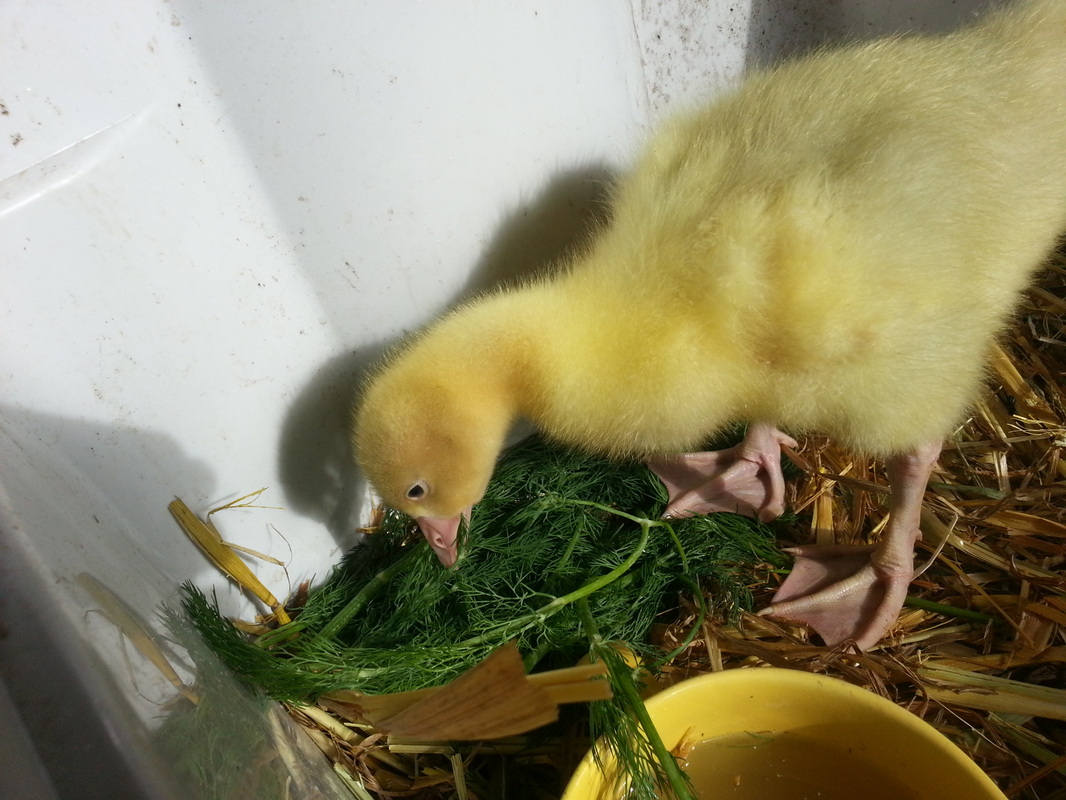
Geese prefer greens to any other food, yet most owners do not feed them anything but a prepared feed that is dry and comes from a bag. Here he is enjoying some fresh dill.
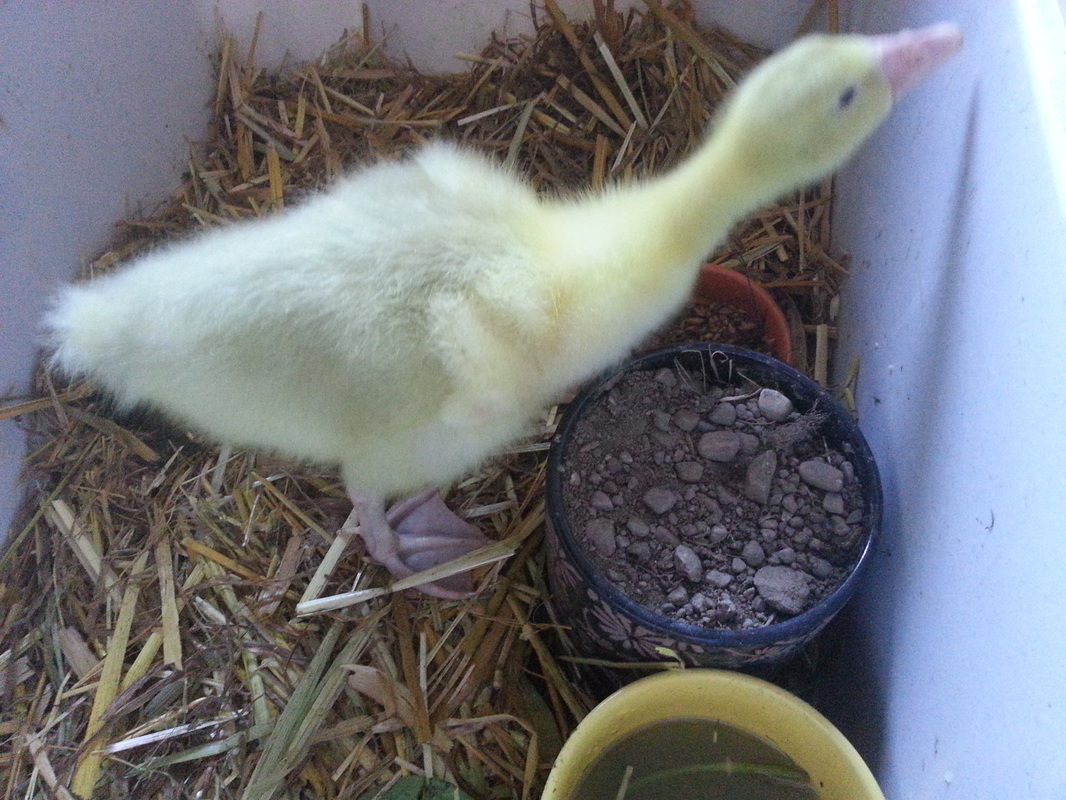
His bucket of sandy dirt is central to the water and feed.
This is a little Sebastopol goose. When the babies are hatched by their mothers, they are taken out daily with the goose to look for food. She shows them what is good to eat, and it is not genetically modified smashed grains with salt and minerals that today's waterfowl enthusiasts are told to feed the goslings. Primarily, when given a choice, geese eat grass and weeds, but grass is their first choice. They like some grain to go along with that and they also eat bugs, slugs and some flying insects, but are not big on worms. One substance that they do eat is dirt, especially sandy dirt, but they like black dirt too. In some areas that have been chemically fertilized frequently or have had pesticides applied, eating dirt and grass might not be the best choice. Here, at the Fat Ewe Farm, they can fill their boots, um, bills.
So, when it came to feeding the gosling in the house, who lives in a very large Rubbermaid container, what would best emulate his natural diet. Dirt, yes, especially sandy dirt (he picks the rocks out), grain, but the grain he gets is organic rolled oats or stone ground oats, and soaked wheat, barley and oats. For added protein, since there are no slugs or bugs to offer, an ounce of hemp seed is added to the grain. His soaked grains are beginning to sprout, which is even better, and eventually, hopefully will send out green leaves. Voila! grass in winter. Technically, it is spring, however; there is still snow on the ground and no green grass to be seen. The gosling also gets spinach, which is high in vitamins and protein and salad mix when it is half price at the grocery store. He is quite happy and goes from his sprouted grain to the dirt, then the water and back and then demolishes his greens. After that it is nap time.
As long as I am where he can see me, he huddles in a corner and sings to himself as he falls asleep, but as soon as I am out of his sight, he calls to me as he would to his mother if she was not visible. I feel sorry for him, alone, no mother, no siblings. I try not to spend a great deal of time with him, but do pick him up several times a day. He settles into my hands and is quiet then and it seems to me, he quite enjoys this contact. At night, now, finally, he is fairly quiet as long as it is dark. When the dawn comes, he is hungry and searching for good things to eat. By then his water is muddy from the dirt and the sides of the container are spattered with watery mud and some accidents he had when bending over. Every day the small house has to be cleaned and the straw changed.
When he is a little bigger and does not need a constant warm temperature, (he doesn't require a heat source anymore, but does need the warmth of a house, at least 20 degrees Celsius), he can go outside in a pen. Last year, the raven ate the goslings through the wire pen, but it was where the dogs could not mind it. This year, I will be sure to put the pen where the dogs can keep the ravens at bay. Robbie, especially, is the sky hunter now, and is trained to chase ravens. He loves it because it is something he can think to do himself and he can run and chase legally! This Sebastopol gosling cost $100 dollars, plus 2 hours of driving to get him. Because they are rare, Sebastopol geese are rather pricey. A grown goose can be several hundred dollars and a show goose, maybe four hundred or so . Sebastopol geese do have low fertility and lay few eggs, so their numbers have remained low. They are often kept as lawn ornaments because of their beauty, with long swan like necks, blue eyes and ruffled snow white feathers. The gosling is not sexed, so whatever he is, goose or gander, he is fun to watch and most welcome at the Fat Ewe Farm.
So, when it came to feeding the gosling in the house, who lives in a very large Rubbermaid container, what would best emulate his natural diet. Dirt, yes, especially sandy dirt (he picks the rocks out), grain, but the grain he gets is organic rolled oats or stone ground oats, and soaked wheat, barley and oats. For added protein, since there are no slugs or bugs to offer, an ounce of hemp seed is added to the grain. His soaked grains are beginning to sprout, which is even better, and eventually, hopefully will send out green leaves. Voila! grass in winter. Technically, it is spring, however; there is still snow on the ground and no green grass to be seen. The gosling also gets spinach, which is high in vitamins and protein and salad mix when it is half price at the grocery store. He is quite happy and goes from his sprouted grain to the dirt, then the water and back and then demolishes his greens. After that it is nap time.
As long as I am where he can see me, he huddles in a corner and sings to himself as he falls asleep, but as soon as I am out of his sight, he calls to me as he would to his mother if she was not visible. I feel sorry for him, alone, no mother, no siblings. I try not to spend a great deal of time with him, but do pick him up several times a day. He settles into my hands and is quiet then and it seems to me, he quite enjoys this contact. At night, now, finally, he is fairly quiet as long as it is dark. When the dawn comes, he is hungry and searching for good things to eat. By then his water is muddy from the dirt and the sides of the container are spattered with watery mud and some accidents he had when bending over. Every day the small house has to be cleaned and the straw changed.
When he is a little bigger and does not need a constant warm temperature, (he doesn't require a heat source anymore, but does need the warmth of a house, at least 20 degrees Celsius), he can go outside in a pen. Last year, the raven ate the goslings through the wire pen, but it was where the dogs could not mind it. This year, I will be sure to put the pen where the dogs can keep the ravens at bay. Robbie, especially, is the sky hunter now, and is trained to chase ravens. He loves it because it is something he can think to do himself and he can run and chase legally! This Sebastopol gosling cost $100 dollars, plus 2 hours of driving to get him. Because they are rare, Sebastopol geese are rather pricey. A grown goose can be several hundred dollars and a show goose, maybe four hundred or so . Sebastopol geese do have low fertility and lay few eggs, so their numbers have remained low. They are often kept as lawn ornaments because of their beauty, with long swan like necks, blue eyes and ruffled snow white feathers. The gosling is not sexed, so whatever he is, goose or gander, he is fun to watch and most welcome at the Fat Ewe Farm.
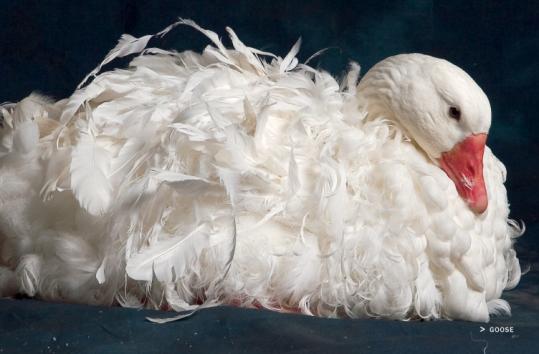
And when he grows up, this is the beautiful creature he will become.
 RSS Feed